Memoir, Pop Culture, Princess, Raves, Suburban

Dallas vs. Dukes – A Friday Night Dilemma

dallasthe-dukes-of-hazzard

Larry Hagman died last week.  He was 81 and, by all accounts, was as nice a person as his alter-ego, J.R. Ewing, was nasty.

Coincidentally, also last week, my dad bought a new TV to replace the old one he had in his basement. Now, when I say old, I don’t mean 10 years old, I mean 1975 old! This was the very first color TV our family ever owned. We got it when I was in junior high. It only got the first 12 channels because there were only 12 buttons next to the screen. (You had to get your butt up off the couch if you wanted to change the channel.) But that was OK if you were living in New Brunswick in the 1970’s, because we only got two channels.

Every Friday night, my family (Mom, Dad, little bro, the beagle and me) would gather in our tiny family room to watch TV. We would break open the one bag of chips and the one bottle of pop. It was my mother’s job to divide the chips evenly into 4 plastic bowls – one for each of us. We couldn’t just share a bowl. That was crazy talk. And we’d each have a small glass of pop. I think we shared the same amount of pop among the four of us that I got at the movie theatre the other night for myself. (Hellooooo? people? When did we forget about portion size?)

Like I said, we only got two channels and for some reason unknown to anyone with a clue, the great programming gods of the day decided to put the two most popular shows of the time on opposite each other. So, every Friday night we had a dilemma.

Dukes or Dallas?

Usually we opted for fairness and equality. One week Dukes, one week Dallas. But remember, this was before DVRs, YouTube and even VCRs. If you missed a show, you missed it, unless somehow you were lucky enough to catch a repeat of the show months later and by then it didn’t matter. You already knew what happened.

Mom and I were already fans of Dallas, thanks to the casting of Patrick Duffy – the Man from Atlantis. (He was so cute with those little webbed feet.)

the_man_from_atlantis-show

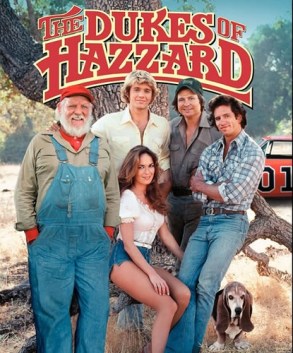
My brother and father were big fans of the Duke boys and their crazy uncle, the evil Boss Hogg and, of course, Daisy Duke in her little jean shorts. (The dog was good either way. She was just happy to be inside, on the couch, with her peeps.)

catherine-bach-122284

(Sorry guys, no short shorts, but at least you can see the car!)

Don’t get me wrong. I didn’t hate it when we had to watch D.O.H. Them Duke boys was awful cute and the show was funny, in a hillbilly sort of way. They were the original Here Comes Honey Boo-Boo family.

But I loved Dallas. I loved the theme music and the fact that everyone was so rich and beautiful. J.R. was the man you loved to hate. He said the most vile things with a smile on his face. And he was funny – wickedly funny. When J.R. was shot in Season 9, we spent months waiting and debating with the rest of the world about Who Shot J.R.?  On November 21, 1980 we gathered in our little family with our chips and pop and watched, with the 350 million other people who tuned in, to see who the culprit was. (In case you were living in a cave during that time, it was his mistress, Kristen. No wonder. He was really, really mean to her.)

Dallas started when I was 12, a dorky girl with a pageboy boy haircut, and wrapped it’s finally episode when I was 25, a married woman juggling a job, a husband and a house full of pets. Dallas was a part of my growing up.

jr ewing

“I know what I want on JR’s tombstone,” Hagman once said. “It should say: ‘Here lies upright citizen JR Ewing. This is the only deal he ever lost.'”

Rest in Peace, J.R.

_____________________________________________________________________

If you only had two channels, which would you have picked? (Remember: you’re only 12. You got nothin’ else to do.)

Dukes of Hazzard opening sequence: http://www.youtube.com/watch?v=hxD0PqVlt5Q

The best of J.R. If you were a fan of Dallas or you just like funny stuff, check this out:

http://www.youtube.com/watch?v=GZV3365a7Ew&feature=related

Rants, Raves, Teacher

If we can’t direct the winds, we must adjust our sails – The case of Jeffrey Moore.

Chris Jeanguenat, Sailboats in Stormy Seas

It’s easy to understand why schools are built with wheelchair ramps – without the ramp, a child in a wheelchair would not be able to access the same educational services as other children his or her age. (Insert – duh! – here.) Even the most curmudgeonly among us would have a hard time complaining about taxpayer money being spent to install a ramp at a school.

When a child’s disabilities are invisible, however, that’s when things start to get confusing for some people.  A child with a learning disability has average to above average intelligence and, like most of us, has areas of strength but also areas of serious weakness. These challenges often require extra support, alternate programming and adaptations in order for that child to be successful. This, like anything else that steps outside the norm, costs money. And once you start talking money, human compassion starts to wane.

Recently the Supreme Court of Canada ruled in favor of a family who took their child out of public school in British Columbia in grade 4 and put him in a private school when it became clear the school could not meet his special learning needs.

In the early 1990’s, Jeffrey Moore was struggling to keep up with his Grade 2 classmates. Despite extra help from his parents and teachers, Jeff could still not read. The school psychologist was brought in and it was discovered that Jeff had a learning disability – dyslexia, which meant he had great difficulty reading. She recommended that he attend the local diagnostic centre in order to receive the help he needed. Unfortunately, before Jeff had a chance to enroll, the local school board closed the centre. By this point, Jeff was suffering from low self-esteem, constant headaches, stress and was falling further and further behind his peers. His school was offering him the same services that other children with his issues were getting, but they weren’t enough. He needed specific services that his public school and school board were unable to provide.

Based on recommendations from the school psychologist, Jeff’s parents felt their only option was to enroll him in a private school for children with learning disabilities. So they did. It was expensive but it worked. Jeff’s reading improved and he was a much happier little boy. But his parents felt it wasn’t fair. They felt the government had a responsibility to provide an education to all students, even those with learning disabilities.

So, in 1997, Jeff’s father, Frederick Moore, filed a human rights complaint against the School District and the British Columbia Ministry of Education alleging that Jeff had been discriminated against because of his disability and had been denied “a service . . customarily available to the public”, contrary to s. 8 of the Human Rights Code, R.S.B.C. 1996, c. 210.

Basically what Jeff’s parents were asking was for their child to be given the same chances as every other child to be successful at school. Because of his learning disability, he needed something extra in order to level the playing field. He needed a ramp upon which he could climb the hill that dyslexia had put in front of him.

This is the analogy Madam Justice Rosalie Abella used when awarding the unanimous decision of the Supreme Court in favor of Jeff and his parents.

Adequate special education, therefore, is not a dispensable luxury. For those with severe learning disabilities, it is the ramp that provides access to the statutory commitment to education made to all children in British Columbia.” Moore v. British Columbia (Education),2012 SCC 61.

The justices awarded Jeff’s parents $100,000 for the costs involved for his private schooling. Jeff, now 23, was awarded $10,000 for the discrimination he suffered.

Jeff’s father said he was driven to take the case as far as he could because he felt public schools had an obligation to help all children succeed.  Moore’s lawyer Frances Kelly said the decision sets a national precedent and sends a message to all public schools. “This is a warning to them that they have to comply with their duties under the human rights code to ensure that students with learning disabilities have the same access to education as other students.” (http://www.vancouversun.com/news/education/North+Vancouver+school+district+discriminated+against/7524870/story.html#ixzz2CPUpXZ4v)

The Globe and Mail published an editorial immediately following the ruling strongly condemning the Supreme Court for “overstepping its authority”.

The Supreme Court of Canada has opened a Pandora’s box for public school boards by finding that a British Columbia school district discriminated against a dyslexic child when, during a financial crisis, it closed a special-education centre that provided him intensive help in learning to read. From here on, schools, school boards or provinces could be forced to bleed other programs to meet court-ordered educational standards for special-needs students. (http://www.theglobeandmail.com/commentary/editorials/supreme-court-ruling-on-special-education-opens-pandoras-box/article5169193/)

On November 16, the Vancouver Sun published an opinion piece by Derek James From, a staff lawyer with the Canadian Constitution Foundation. It reads like diatribe from a right-wing American pundit. He notes that Jeffrey is now making a good living as a plumber and therefore, no blood, no foul.

Perhaps it’s Jeffrey, not the hard-working B.C. taxpayers, who should pay his father back.”http://www.vancouversun.com/news/Supreme+Court+ruling+rejects+equality+favour+another/7562452/story.html#ixzz2CnAp9F1R

Wow – talk about totally missing the point. Jeffrey is making a good living now thanks to the fact that he was taken from his public school and put in a private school, at his parent’s expense, where his needs were met. Who knows where he would be now if his parents had not been able to make this commitment?

But Jeffrey Moore’s individual situation is not the point of this story. The Supreme Court of Canada has said that children with learning disabilities have every right to be taught the way they learn. I will repeat: Children have a right to be taught the way they learn. We have to stop cramming our little square pegs into round holes. It’s not working. These children have a disability that requires a “ramp”. Just because it’s not visible doesn’t mean it’s not there. And yes, it’s going to cost money. Probably lots of money. But the argument that this will hurt the so-called average child is bull-puckey. Any teacher who has ever taught a class that includes a child with a learning disability (and that would be every teacher in North America, I would guess) can tell you that having no support for that child affects every other child in the room. I have had classes where, no lie, half of my class had some sort of learning difference, some very severe, and classroom support was minimal. When those children don’t have the supports they need, do you know who provides it? The classroom teacher. And who suffers when the classroom teacher’s attention is pulled in one direction and then another? All of the children, even the so-called average kids.

This ruling by the Supreme Court may change the face of education. And I hope it does. We are going to have to re-think the way we do things. There isn’t an endless pot of money at the end of the rainbow. Things will have to cut and reduced. The status quo is going to have to change in order to meet the needs of all children. And so it should.

The winds have changed. It’s time to adjust out sails.

Read the full Supreme Court ruling (ie. the legal mumbo-jumbo) here: http://scc.lexum.org/decisia-scc-csc/scc-csc/scc-csc/en/item/12680/index.do

Rants, Raves, Teacher

Ensuring Good to Great-Teaching 21st century kids in a 21st century world

Quick: what’s the first rule of Fight Club? Remember the 1999 movie starring Brad Pitt where he takes his shirt off a lot and fights other buff guys in basements and parking lots? (OK, stop thinking about that now. Focus. Back to me.) So, the first rule of Fight Club?  You do not talk about Fight Club. The second rule of Fight Club is: you DO NOT talk about Fight Club.

Being part of the teacher’s union is sort of like being part of Fight Club (minus the hot guys with their shirts off – that may happen in some places but sadly, never where I’ve worked).  As a teacher, I do my job and I don’t talk about what my union is doing, at least not in a non-positive, super-supportive way. Now don’t get me wrong. I appreciate everything my union has done for me. God knows, if I had to teach and negotiate my own contract, I would have left long ago. They allow me to do my job; however, just as there are things I could do better as a teacher, I think there are things my union could do better as well.

Across North America we are seeing teacher unions decimated by their government leaders and demonized in the court of public opinion. In order to balance budgets and leave no child behind, governments have slowly but surely worked to take power and control away from the unions and put it into the hands of administrators. In response, many unions have retaliated by threatening to strike, only to have that option legislated away. When they use the only other means available to them, their actual work with children, they find themselves attacked by parents and the press. Teachers are only in the profession for the money, the benefits and the summers off! It seems like teachers and their unions just can’t win.

So, where do we go from here?

While researching teacher unions in the 21st century, I came across an interview with Randi Weingarten, president of the American Federation of Teachers.  Ms. Weingarten, whose union represents more than 1.5 million teachers across the United States, was a key speaker at the Aspen Ideas Festival this summer. Her presentation Can Teacher Unions be Partners in Reforming Schools in the 21st century? focused on what teacher unions need to do better in this ever-changing world.

She admitted that unions, hers in particular, haven’t always put quality teaching at the forefront.

“We…were wrong. Not that we meant to be wrong but our job initially was about fairness, not about quality. Our goal was to make sure teachers and our other members were treated fairly. Our job has to be about quality as well. Due process has to be about fairness, not about job security for life. Not about being used as an excuse for managers not to manage or a cloak for incompetence.”

She said it’s not enough for some teachers to be great.

“What we have to do is ensure good to great for all teachers.”

In response to questions posed by Walter Isaacson, President and CEO of the Aspen Institute, Ms. Weingarten touched on a variety of subjects, including the controversial “bar exam for teachers”, but her focus always went back to making teachers accountable.

“We need to have real evaluation systems that can assess whether teachers are doing their jobs. And if they’re not, you help them. If they’re not, they shouldn’t be teachers.”

“What we have seen is that schools that work…have collaborative environments where there’s a real thoughtful process for how you recruit, support, retain and yes, dismiss, teachers.”

So, how do we make certain that our children are getting the teachers they deserve?

First, she said, we need to ensure that teachers have the tools and conditions they need in order to teach properly.

“You can’t give new teachers a rigorous kind of methodology to teach and then basically say, ‘You’re on your own.’ It’s not fair to the kids and it’s not fair to the teachers.”

Then, she said, teachers need to ask themselves: Did I teach the material? And most importantly: Did the students learn it? This is where standardized testing has a role to play. Sometimes a teacher can present a lesson and feel that it was the best lesson she has ever taught, only to discover that the majority of students didn’t really understand.

Ms. Weingarten was quick to point out that while standardized tests serve a purpose, they should not become the end goal.

“You have to look at the data to see if kids get it,” she told the audience. “You have to have enough data so that people concentrate on it, but when it becomes predominant then education becomes about testing and not about teaching and frankly the current generation of tests have no connection with what we have to teach kids right now. [They] are about the memorization of facts as opposed to about how kids critically think.”

If the jobs of tomorrow require critical thinking and creativity, why are we still teaching kids to memorize facts and then regurgitate them on a series of standardized tests? According to Ms.Weingarten, this focus on testing is one of the most serious problems facing education today.

Teachers need to be trained to teach critically, she said. New teachers need to be able to walk into a classroom feeling prepared, as opposed to the ‘sink or swim’ model we have now. Half of all teachers in the United   States leave teaching within the first three to five years, she pointed out.

“Love is important. You have to love kids to be a school teacher. You have to know your content. And you have to have a pedagogical bag of tricks so that you can differentiate instruction.”

This ability to offer differentiated teaching is what makes teachers great, she said.

“It’s how we go to our toolkit and understand that Walter is different than Randi, that Celia is different than Michael. [It’s] how we actually engage with kids to try to create that seminal moment of learning.”

At the end of her presentation, she went back to her initial question: can teacher unions be a part of educational reform in the 21st century?

“If we actually want to help all kids, the union needs to be a partner in this,” she said. “At the end of the day, if we don’t start focusing on…how we are solution-driven, how we problem solve, how we ensure that all kids get what they need in the public space instead of this constant polarization, education is not going to get better.”

And that’s the goal, isn’t it? To continue to improve education so that it meets the needs of all children? Having unions and governments, parents and teachers, all at each other’s throats does nothing to help students. We need to work together to figure out how best to teach 21st century kids in the 21st century.

So, I’m doing it. I’m breaking Rules #1 and #2 and I’m talking about my union (albeit anonymously and with loads of trepidation). I am grateful for everything they do but I want to make sure the voices of students are heard above all else. In the long run, I think it’s the best thing for me, as a teacher and a parent, and for our planet as a whole.

___________________________________________________________________

Presentation at the Aspen Ideas Festival, June 30, 2012 – “Can Teacher Unions be Partners in reforming schools in the 21st century?” Link to complete video of presentation: http://www.aspenideas.org/session/can-teacher-unions-be-partners-reforming-schools-21st-century

Pop Culture, Princess, Rants, Raves, Suburban, Teacher

Sticks and Stones…Why words can hurt us

There are a lot of things I don’t understand, like people’s love of scotch (it tastes like cleaning oil), physics, and the public fascination with US uber-conservative and lawyer, Ann Coulter. This woman is a nasty piece of work. I can only imagine that she must have suffered some terrible pain in her lifetime that has made her dead inside to the feelings of others. Recently , Ms. Coulter tweated that she approved of Governor Romney’s decision to be kind and gentle to the “retard” during the third presidential debate. Seriously?!

Despite on-line condemnation from everyone everywhere, including Special Olympian John Franklin Stephens, Ms. Coulter defended her choice of words a week later on the Piers Morgan show. She said she wasn’t insulting people with mental challenges; she was insulting the president. She said she chose the word “because it’s a synonym for ‘loser.’” Seriously…again?! That doesn’t make it better!!!

But she’s right. The term ‘retard’ is most often used as an insult and it’s used because it implies that the person being insulted is not smart and a loser. But the part that Ms. Coulter seems to have missed is that’s why it’s not used by polite, caring society anymore. That’s why newscasters and reporters are referring to it as the ‘r-word’; because, it dehumanizes people with mental disabilities, therefore making it OK to abuse them.

And that’s the problem with words – they can be used to dehumanize others so that we can abuse them without any fear of guilt. On a global scale, it’s what the Nazis did when they rounded up the Jews. They dehumanized them making it OK for their soldiers to torture and kill them. On a smaller scale, this is also what happens with bullying. Call a girl a “slut” and it’s a lot easier to make fun of her and victimize her. Call a boy a “gay loser” and it’s a lot easier to beat him up and say hateful things about him. These people become “things” and not human beings anymore.

This thinking goes beyond hatred and moves into contempt. It means that you consider someone worthless or inferior to you. Once you don’t care about something, you are free to be as cruel as you want without fear of guilt, empathy, compassion or sympathy. In her book, Just because it’s not wrong, doesn’t make it right, Barbara Coloroso quotes Lieutenant-General Romeo Dallaire on how the world was able to ignore the genocide in Rwanda. He said that with silent indifference, the international community endorsed, “the ethical and moral mistake of ranking some humans as more human as others.”

So, Ms. Coulter, when you use the ‘r-word’ and say that you only did so because, in your mind, it’s a synonym for loser, I believe you. But if your end goal was to dehumanize the president so that we would all join you in your campaign of contempt, I think you missed the boat there. The only person dehumanized by this exchange was you.

The only conclusion I can reach is that we are in desperate need of a transfusion of humanity. If we believe that all humans are human, then how are we going to prove it? We can only prove it through our actions. Lieutenant-General Romeo Dallaire, Shake Hands with the Devil: The Failure of Humanity in Rwanda.

Memoir, Raves, Teacher

Those perfect days

Today was one of those days that makes you think, “Yeah, I chose the right career.”

My students performed two plays – just cheap little reader’s theatre plays right out of a book – nothing too crazy or creative. But they took these little plays and turned them into their own. They created props and backgrounds. They brought in costumes. They made posters. I just backed farther and farther away until they were working pretty much on their own. Keep in mind, that these kids are 9 and 10 years old. It was hard not to take over, change things, make it “better”. Instead, I sat on my hands, bit my tongue and just tried to control the chaos that creativity brings.

This afternoon they took to the stage. The kids who were behind the scenes, the stagehands and props people, were as excited as the actors. 600 kids, teachers, and parents watched them as they performed their 5 minute plays. After they were done, they were exhilarated. They said, “Can we do that again???”

You bet we’ll do it again.